Puppy Growth Calculator
*Disclaimer – This puppy growth calculator provides an estimated adult weight based on general growth formulas and average breed size ranges. Results are for informational purposes only and may not be accurate for every dog. Genetics, nutrition, health, and veterinary care all play a role in how large your puppy will become. This tool is not a substitute for professional veterinary advice. If you have concerns about your puppy’s growth, diet, or health, consult a licensed veterinarian.
Puppy Growth Calculator: How Big Will Your Puppy Get?
Bringing home a new puppy is exciting, but one of the first questions most pet owners ask is: How big will my puppy get? Whether you’re preparing your home, choosing the right food, or simply curious, understanding your puppy’s future size can help you plan ahead.
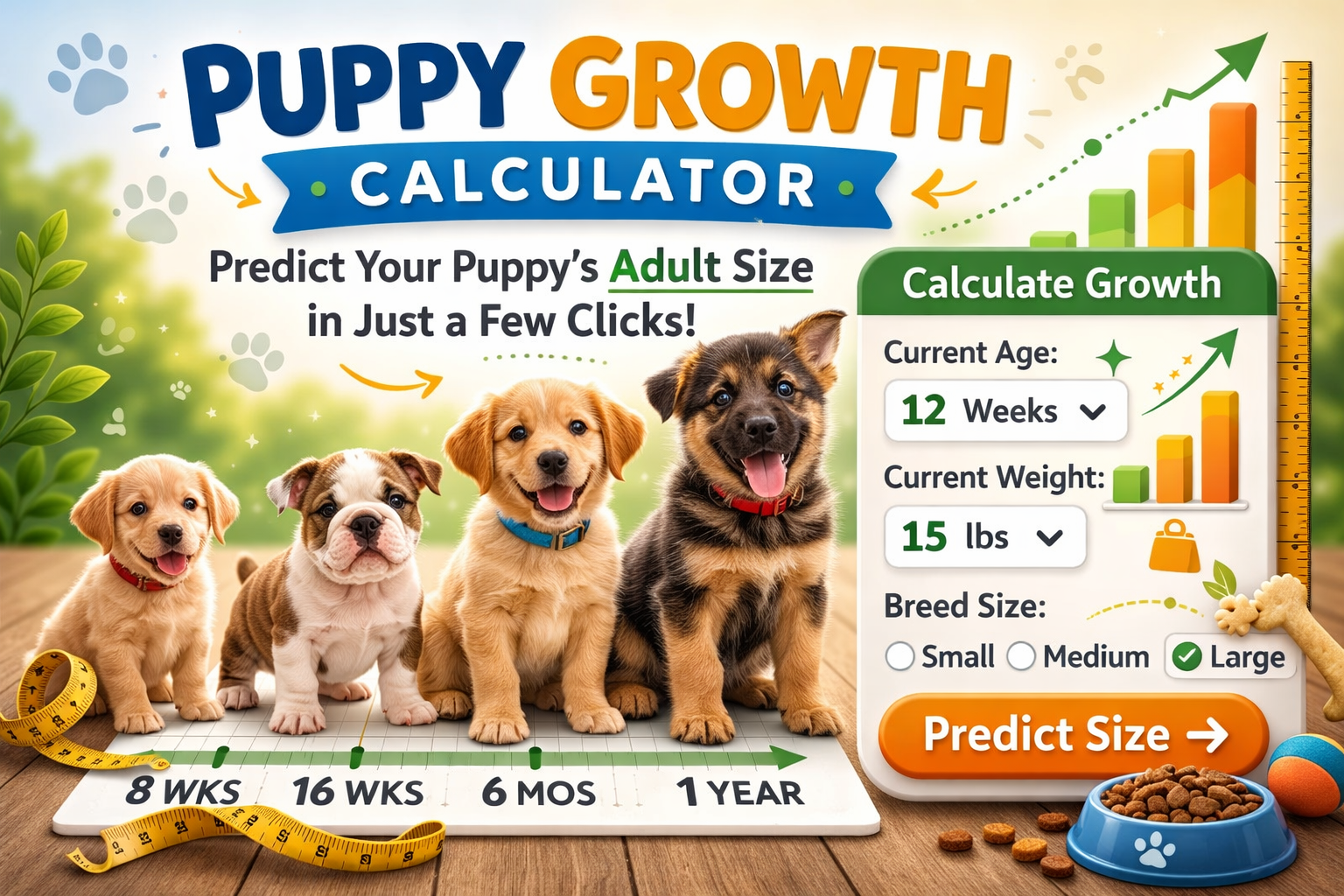
That’s exactly why we created this Puppy Growth Calculator—a simple tool that estimates your dog’s adult weight based on age, current weight, and breed size. While no calculator can predict the future with perfect accuracy, this tool gives you a realistic estimate based on veterinary growth formulas and common breed growth patterns.
You’ll learn how puppy growth works, how to use the calculator, what affects your puppy’s final size, and how to support healthy growth from puppyhood to adulthood.
Why Puppy Growth Matters
Puppies grow fast—especially in their first year of life. Understanding their growth curve helps you make better decisions about nutrition, training, and long-term care.
Knowing your puppy’s estimated adult size can help you:
- Choose the right crate, bed, harness, and collar
- Prepare your home for a small, medium, or large dog
- Select the right type and amount of food
- Understand exercise needs and joint health risks
- Budget for grooming, veterinary care, and long-term expenses
For example, a puppy that will grow into a 10-pound adult dog has very different needs than one that will grow into a 100-pound adult dog. A puppy growth calculator gives you a helpful starting point so you’re not guessing.
How the Puppy Growth Calculator Works
The puppy growth calculator uses three main pieces of information:
- Your puppy’s age in weeks
- Your puppy’s current weight
- Your puppy’s breed size category
Veterinarians, breeders, and researchers use similar formulas to estimate adult weight. While there are many methods, most rely on the fact that puppies grow rapidly in the first few months and slow down as they approach adulthood.
Step 1: Enter Your Puppy’s Age
Age is one of the most important factors in predicting adult size. Puppies experience their fastest growth between 6 and 16 weeks of age. After that, growth continues but slows gradually.
For the most accurate estimate, enter your puppy’s age in weeks. If you only know their age in months, multiply by 4 to get an approximate number of weeks (for example, 3 months ≈ 12 weeks).
Step 2: Enter Your Puppy’s Current Weight
Your puppy’s current weight is used to calculate how quickly they are growing. For best results, weigh your puppy using a pet scale or a household scale. You can weigh yourself, then weigh yourself holding your puppy, and subtract the difference.
Step 3: Select Breed Size Category
Different breeds grow at different rates, so the calculator uses breed size categories to adjust the estimate. These categories include:
- Small breeds: Under 25 lbs as adults (Chihuahua, Toy Poodle, Yorkshire Terrier)
- Medium breeds: 25–50 lbs as adults (Beagle, Border Collie, Cocker Spaniel)
- Large breeds: 50–90 lbs as adults (Labrador Retriever, Golden Retriever, German Shepherd)
- Giant breeds: Over 90 lbs as adults (Great Dane, Mastiff, Saint Bernard)
The calculator applies a growth multiplier based on these size categories to estimate adult weight.
Example Puppy Growth Calculation
Let’s walk through an example to see how the puppy growth calculator works.
Imagine you have an 8-week-old Labrador Retriever puppy that weighs 10 pounds. You enter:
- Age: 8 weeks
- Weight: 10 pounds
- Breed size: Large
The calculator adjusts for the puppy’s age and growth rate and estimates the adult weight. While the exact number will vary depending on genetics and nutrition, this gives you a realistic projection so you know what to expect.
Remember, this is an estimate—not a guarantee. Some Labradors grow larger or smaller depending on their lineage and lifestyle.
Factors That Affect Puppy Growth
Even the most advanced puppy growth calculator can’t predict everything. Several factors influence how big your puppy will become.
Genetics
Genetics play the biggest role in determining adult size. If both parents are large, the puppy is likely to be large. Mixed-breed puppies can be more unpredictable, especially if the parents are unknown.
Breed Type
Different breeds have different growth patterns. Small breeds mature faster, while large and giant breeds grow for a longer period. Some giant breeds continue growing until they are 18 to 24 months old.
Nutrition
Nutrition is critical for healthy growth. Puppies need a balanced diet with the right amount of protein, fat, vitamins, and minerals. Overfeeding can cause rapid growth and joint issues in large breeds, while underfeeding can stunt growth.
Exercise and Activity
Exercise helps puppies develop strong muscles and bones, but too much high-impact exercise in young puppies can stress developing joints. Moderate, age-appropriate activity is best.
Health and Veterinary Care
Parasites, illnesses, and hormonal conditions can affect growth. Regular veterinary checkups ensure your puppy stays on a healthy growth curve.
Spay and Neuter Timing
Spaying or neutering can slightly affect growth patterns. Some dogs neutered early may grow a bit taller due to delayed growth plate closure. Your veterinarian can help you choose the best timing.
Puppy Growth Chart vs. Puppy Growth Calculator
You may have seen puppy growth charts that show average weights by age and breed. These charts are helpful, but they are based on averages and don’t account for your puppy’s individual growth rate.
A puppy growth calculator is more personalized because it uses your puppy’s real data. While charts provide general guidelines, a calculator gives you a tailored estimate.
For the best results, use both tools and track your puppy’s weight over time.
When Do Puppies Stop Growing?
Puppies stop growing at different ages depending on their size:
- Small breeds: 9–12 months
- Medium breeds: 12–15 months
- Large breeds: 15–18 months
- Giant breeds: 18–24 months
Even after reaching their adult height, dogs may continue filling out and gaining muscle for several months.
Tips to Support Healthy Puppy Growth
Helping your puppy grow into a healthy adult dog requires proper care and attention. Here are some tips to support healthy growth.
Feed a High-Quality Puppy Food
Choose a puppy formula designed for your dog’s size category. Large-breed puppy food, for example, is formulated to support slower, controlled growth to reduce joint problems.
Avoid Overfeeding
It’s tempting to give puppies extra treats, but overfeeding can lead to obesity and orthopedic issues. Follow feeding guidelines and monitor your puppy’s body condition.
Provide Age-Appropriate Exercise
Short walks, playtime, and training sessions are great for puppies. Avoid excessive jumping, long runs, or hard surfaces until your puppy’s joints are fully developed.
Schedule Regular Vet Checkups
Routine veterinary visits help track growth, detect health issues early, and keep vaccinations up to date.
Monitor Weight and Body Condition
Use a puppy growth calculator and regular weigh-ins to track progress. You should be able to feel your puppy’s ribs without seeing them clearly.
How Accurate Is a Puppy Growth Calculator?
A puppy growth calculator provides an estimate based on averages and growth formulas. Accuracy depends on several factors:
- Purebred dogs tend to be more predictable
- Mixed breeds can vary widely
- Nutrition and health can influence growth
- Measurement errors can affect results
Think of the calculator as a helpful guide rather than a precise prediction. Your veterinarian can provide the most accurate assessment of your puppy’s growth.
Benefits of Using a Puppy Growth Calculator
Using a puppy growth calculator offers several benefits for pet owners:
- Planning: Prepare your home, budget, and lifestyle for your dog’s adult size
- Nutrition: Adjust feeding amounts based on expected adult weight
- Health: Monitor growth patterns and identify potential issues early
- Education: Learn more about how puppies develop and mature
It’s a simple tool that can make a big difference in how you care for your puppy.
Frequently Asked Questions About Puppy Growth
How accurate is a puppy growth calculator?
Puppy growth calculators provide estimates based on averages. They are generally more accurate for purebred dogs and less predictable for mixed breeds.
When do puppies stop growing?
Small breeds may stop growing around 9–12 months, medium breeds around 12–15 months, and large or giant breeds can continue growing up to 18–24 months.
Can a puppy grow bigger than the estimate?
Yes. Genetics, nutrition, and health factors can cause puppies to grow larger or smaller than predicted.
Should I worry if my puppy is growing too fast?
Rapid growth in large breeds can lead to joint problems like hip dysplasia. Talk to your veterinarian if you’re concerned about your puppy’s growth rate.
How often should I weigh my puppy?
Weighing your puppy every 1–2 weeks during the first few months is helpful. After that, monthly weigh-ins are usually sufficient.
Try the Puppy Growth Calculator Today
Use the puppy growth calculator above to estimate your dog’s adult weight in seconds. It’s a simple, free tool designed to give pet owners insight into their puppy’s future size.
While no tool can replace professional veterinary advice, a puppy growth calculator is a fun and informative way to track your puppy’s development and plan for the future.
Enjoy watching your puppy grow into a happy, healthy adult dog!